Sep 16, 2026
Bone Conduction vs. Air Conduction: How to Tell Them Apart
Bone conduction sends sound through your skull; air conduction uses a speaker. Learn how to tell them apart, and meet the E900/E12 smart camera headphones.
Bone Conduction vs. Air Conduction Headphones: What's the Difference (and Which One Are You Actually Buying?)
Search "bone conduction headphones" on any large marketplace and scroll the first page of results. A surprising share of those listings is not bone conduction at all. Strip away the label and the product underneath is an air conduction, open-ear headset: two small speakers sitting just outside the ear canals. No transducer. No vibration through bone. Some sellers know the difference and use the term anyway because it pulls search traffic; others simply copy whichever listing ranks best. Either way, the buyer ends up with sound they didn't expect and a description that doesn't match the hardware.
We sit on the factory side of this industry. We engineer and manufacture open-ear audio wearables, including the E900 and E12, and we would rather our customers understand the technology than fall for a keyword. So this guide covers three things: how the two sound-delivery methods actually work, three quick tests that tell them apart, and what our E900/E12 open-ear smart headphones do — and what they deliberately don't.
How Bone Conduction Works
A bone conduction headset has no speaker in the traditional sense. It has a transducer — one on each side — pressed against the cheekbone just in front of the ear. When audio plays, the transducer vibrates, and those vibrations travel through the temporal bone directly to the cochlea, bypassing the eardrum entirely.
That bypass is the technology's genuine advantage. Because the ear canal stays open and the eardrum is never involved, bone conduction suits swimmers using fully waterproof models, people who find in-ear tips uncomfortable, and some users with conductive hearing loss whose cochlea still works normally.
The tradeoffs show up in the sound itself. Bone does not carry the full frequency range as faithfully as air, so bass is thin and fine detail gets lost. Turn the volume up and the transducer starts tickling your cheek. That buzzing sensation is distinctive — and, as you'll see below, it is also the fastest way to identify the technology.
How Air Conduction Works
Air conduction is what every speaker ever built does: a diaphragm moves air, the pressure waves travel down the ear canal, and the eardrum converts them into sound. In an open-ear air conduction headset, the drivers are small speakers mounted in the earpieces, angled toward the ear canal without sealing it.
Because air carries the full frequency range far better than bone does, an air conduction design delivers noticeably better bass, clearer vocals, and a more natural timbre at comparable size and price. There is no vibration on your face at any volume. The classic tradeoff is sound leakage at high volume, which a well-designed acoustic chamber keeps under control.
One thing worth stating plainly: air conduction is not a budget imitation of bone conduction. It is the same physics behind every headphone and earbud you have ever owned, packaged in an open-ear form.
Bone vs. Air at a Glance
| Bone conduction | Air conduction (open-ear) |
|---|---|---|
Sound path | Transducer → skull bone → cochlea | Speaker → air → ear canal → eardrum |
How it feels | Vibration on the cheekbone at higher volume | No vibration; sound comes from the speaker grille |
Bass and detail | Limited | Noticeably fuller |
Ear canal | Fully open | Fully open |
Typical users | Swimmers, sensitive ear canals, some conductive hearing loss | Everyday listening, calls, workouts, video capture |
Three Tests That Expose a Mislabeled Listing
1. The plugged-ear test. Put the headset on, play music, then plug both ears with your fingers. A true bone conduction unit gets louder — the sound bypasses your sealed ear canals. An air conduction unit gets quieter, because you have just blocked its only sound path. This single test settles the question in five seconds.
2. The vibration test. Rest a fingertip on the cheekbone in front of each ear at medium-high volume. Bone conduction buzzes against your finger. Air conduction plays sound from the grille but leaves the bone still.
3. The spec-sheet test. If a listing is titled "bone conduction" but the specifications list a 16mm speaker or any dynamic driver, the product is air conduction. Transducers and speakers are different components, and a spec sheet cannot blur that.
None of this means air conduction is the inferior technology — for most listeners it simply sounds better. It means the listing should describe the product honestly, and now you can verify which one you are holding.
Why the E900/E12 Is Air Conduction — On Purpose
The E900 and E12 come from our own production line. We are the source factory behind this hardware, and since its launch in August the model has become our fastest-moving new release. When we designed it, we chose air conduction deliberately, and we say so on the box.
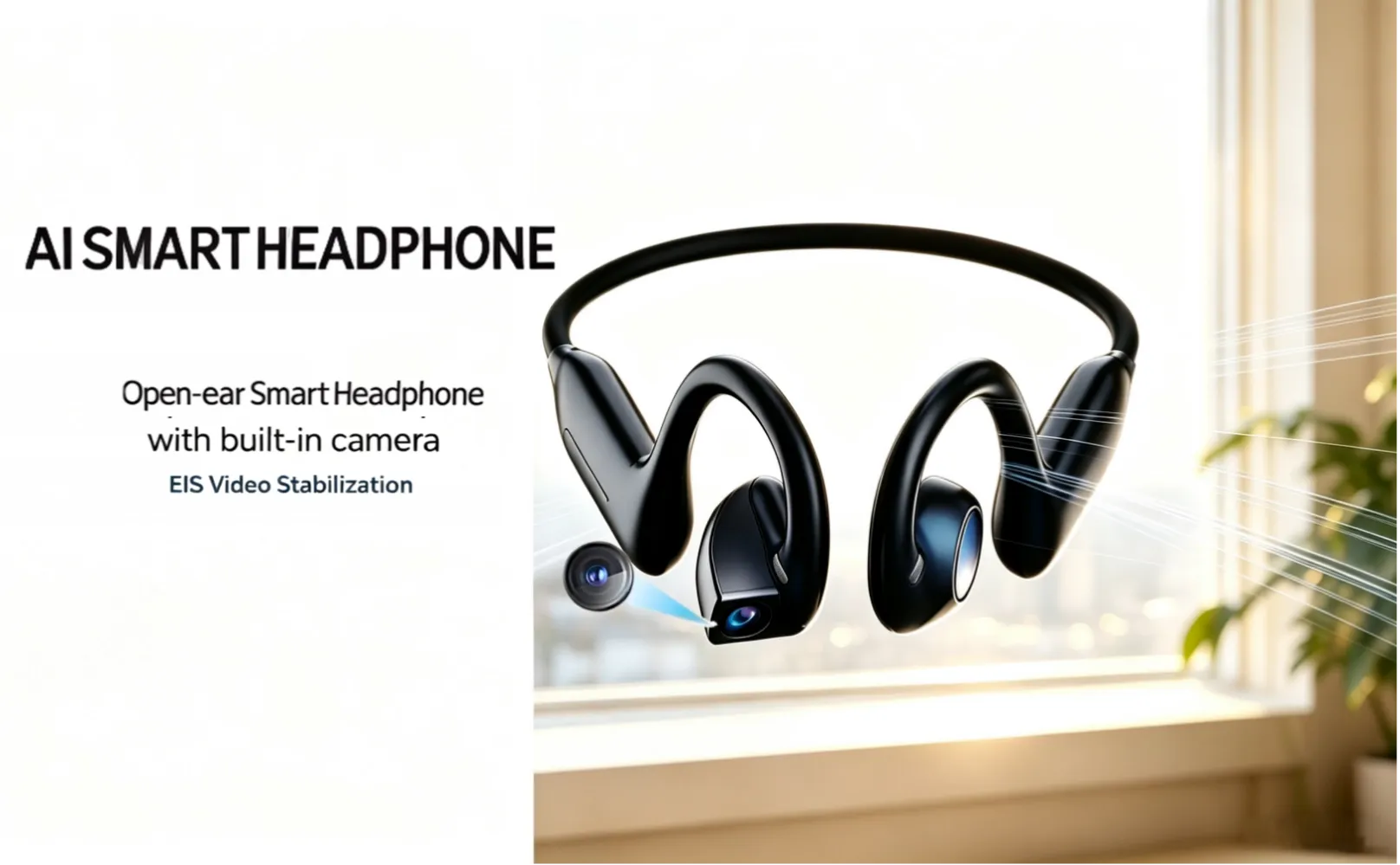
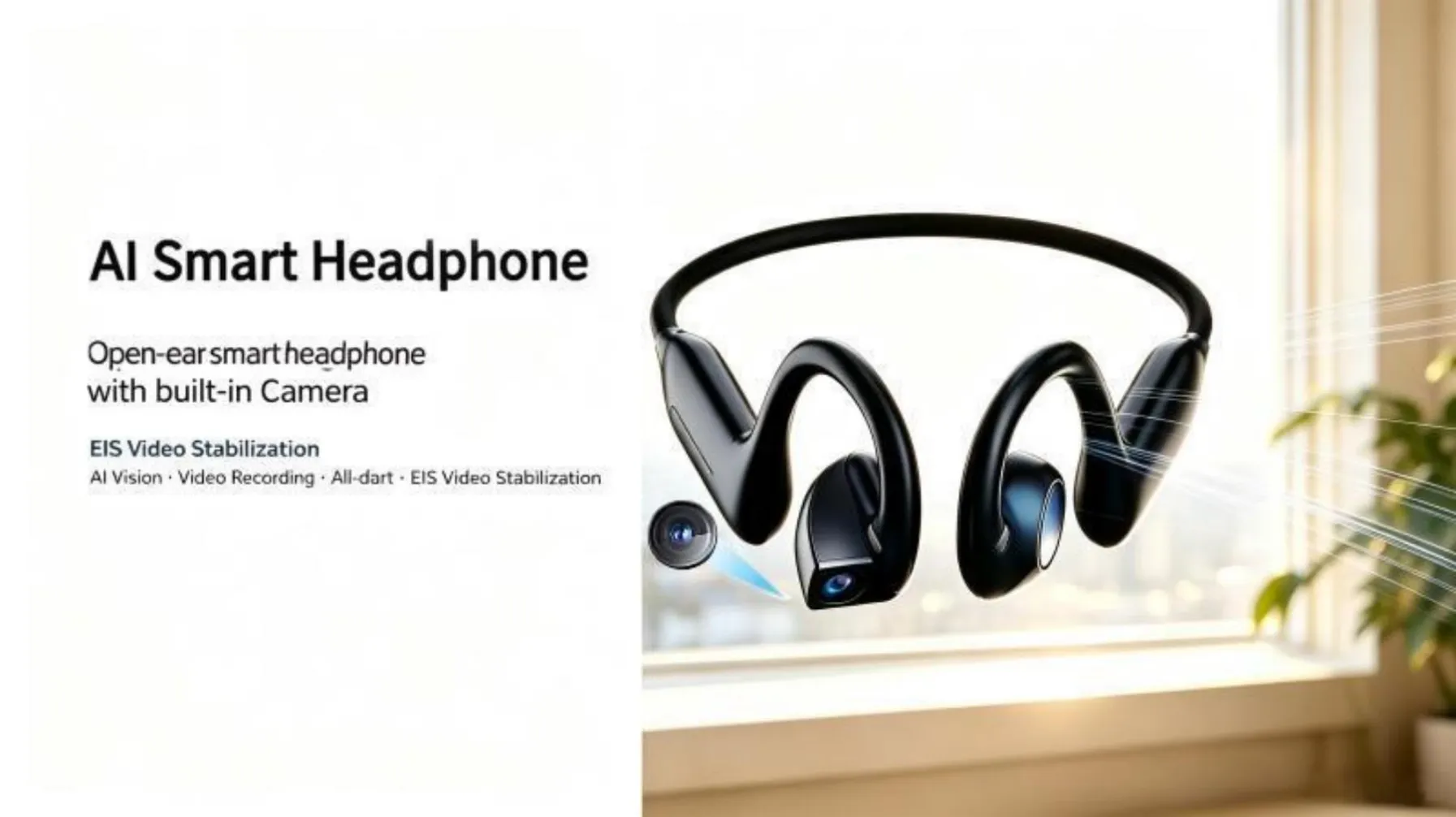
Each side houses a 16mm Hi-Fi speaker, which is why the low end is fuller and vocals sit more naturally than any transducer-based unit can manage. A three-microphone array (−38 dB ± 1 dB sensitivity) handles calls and voice commands, and wear detection knows when the headphones are actually being worn. The touch panel covers daily controls: single tap to play or pause, slide forward or back for volume, double and triple tap to skip tracks. One physical button handles everything related to capture and power.
Then there is the part no ordinary pair of headphones has.
A Camera You Wear, Not Just a Headset
The E900/E12 carries a Sony IMX219 8MP sensor with software-based EIS (electronic image stabilization). A single physical button does the work: press once for a photo, double-press to start video, single-press to stop, triple-press for an audio memo. The white shooting indicator lights up during capture, so people around you always know when recording is active — a transparency feature we consider non-negotiable on a camera wearable.
Clips save to 8GB of onboard storage, with clip lengths of 1, 3, 5, 7, or 10 minutes set in the app, and auto-save when memory fills. Photos, videos, and audio sync to the app over WiFi 6. If you record while the headphones are offline, everything syncs the moment you reconnect. Recording and video functions shut off below 10% battery so a capture never dies mid-file.
An AI Assistant You Talk To
Say "Hi, Luma" and the onboard assistant wakes with a mature female voice. Connected to the app, it runs on large language models including Tongyi Qianwen and OpenAI, and it goes well beyond "what time is it":
- Visual queries. Ask it to describe what is in front of you, identify a car model from a photo, or estimate the calories on your plate.
- Translation. Simultaneous interpretation and conversational translation are both supported.
- Productivity. Meeting minutes, plus audio and video calls.
The assistant also triggers actions directly — say "take a photo" and the shutter fires.
E900/E12 Full Specifications
Hardware
Component | Specification |
|---|---|
Main board | DH98562 SoC + JL7018F audio SoC |
Storage | 8GB |
RAM | DDR3 1GB |
Flash | 128 Mbit |
Camera | Sony IMX219, 8MP |
Stabilization | Software EIS |
Speaker | 16mm Hi-Fi (per side) |
Microphones | 3-mic array, 2718 package, −38 dB ± 1 dB |
Physical buttons | 1 (power / photo / video / audio recording) |
Touch controls | Touch FPC: play/pause, volume, track skipping |
Wear detection | Supported |
Charging | Dual-pin magnetic |
Data transfer | WiFi 6 (photos, videos, audio) |
Indicators | Tri-color status LED; white shooting LED |
Battery | 220mAh (certified for air/sea transport, MSDS) |
Controls, software, and environment
Function | Detail |
|---|---|
Power on / off | Hold 3 s / hold 5 s (force restart: 10 s) |
Photo / video / audio memo | Single press / double press / triple press; single press stops recording |
Auto power-off | 3 min without app connection; 2 min after Bluetooth disconnect |
Recording settings | Clip length 1/3/5/7/10 min; auto-save when full; disabled below 10% battery |
OTA updates | Available at ≥10% battery |
Voice wake-up | "Hi, Luma" (English and Chinese) |
AI model | Tongyi Qianwen, OpenAI (via app connection) |
AI features | Visual queries, simultaneous + conversational translation, meeting minutes, audio/video calls |
Battery protection | Auto power-off at 0%; low-battery alert at 5% |
Operating temperature | 0°C to 55°C |
Charging temperature | 0°C to 40°C (±3°C) |
Humidity | 10–90% RH operating, 5–90% RH storage (non-condensing) |
Frequently Asked Questions
Are the E900/E12 bone conduction headphones?
No. They are air conduction, open-ear headphones built around 16mm Hi-Fi speakers. We chose air conduction for its fuller sound and vibration-free listening, and we label it accurately.
How do I know if headphones are really bone conduction?
Use the plugged-ear test described above. If plugging your ears makes the music quieter, you are listening to air conduction, whatever the listing says.
Is air conduction worse than bone conduction?
Not for most people. Air conduction delivers stronger bass and more natural sound. Bone conduction's advantages apply to specific cases such as swimming with fully waterproof models or sensitive ear canals.
Do open-ear headphones leak sound?
Some do at high volume. The E900/E12's acoustic chambers angle sound toward the ear canal to keep leakage low at normal listening levels.
Where are photos and videos stored?
On the headphones' 8GB onboard storage, then synced to your phone over WiFi 6 through the app.
Does the E900/E12 work without the app?
Basic Bluetooth audio and offline photo/video capture do. AI features, translation, and meeting minutes require an app connection.
The Bottom Line
Buy the physics, not the keyword. If a "bone conduction" headset produces no vibration on your cheekbone and goes quiet when you plug your ears, it is air conduction — which, for most ears, is the better-sounding technology anyway. And if you want open-ear headphones that also carry an 8MP stabilized camera and a voice AI assistant, the E900/E12 comes straight from the factory that builds it. OEM and ODM inquiries are welcome.