Oct 9, 2026Buying Guides
How to Choose an AI Smart Glasses Manufacturer: 8 Questions
Sourcing AI smart glasses? Ask these 8 questions before you order: OEM/ODM terms, EIS, audio, certifications, MOQ and QC — from a Shenzhen factory.
How to Choose an AI Smart Glasses Manufacturer: 8 Questions to Ask Before You Order
Direct answer: The right AI smart glasses manufacturer can show you, not just tell you: named camera module and sensor sources, raw EIS-stabilized 1080P footage, a live translation demo, and CE, FCC, RoHS and UN38.3 files before any deposit. Shortlist factories that quote 500, 1,000 and 5,000 units and document QC steps. Ask all eight questions below on every RFQ. Vague answers become production problems later.
Why the Factory You Choose Decides Your 2026 Sell-Through
Smart glasses sell on demo quality: how the video looks on a normal walk, how clearly calls come through, and whether translation holds up in a noisy store. Weak EIS or poor mic placement drives returns and review complaints, and on Amazon or Lazada early reviews set your season's sell-through. Your factory also sets your landed cost through tooling, MOQ and component choices, and how fast new models refresh your listings. Choose the factory first; the product and listing follow.
Eight Questions to Ask Every AI Smart Glasses Manufacturer
- OEM, ODM or rebranding — and who owns the tooling and IP? ODM customizes a proven platform; OEM means your own enclosure, molds and a written IP agreement; rebranding is logo printing on a closed model. Ask who owns the tooling and design files if the partnership ends.
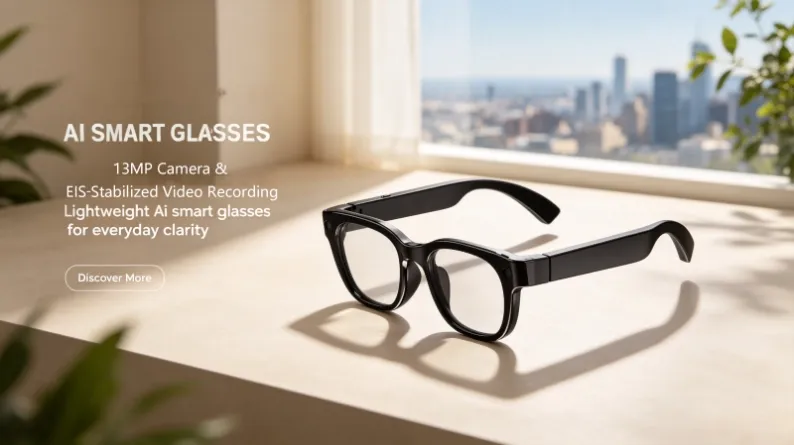
- Where do the camera module and sensor come from, and is the EIS real? Our AI camera glasses pair 13MP/8MP modules with EIS, 1080P video, 8GB storage and electrochromic tint lenses; ask suppliers for the sensor model, module source and raw walking footage. Real EIS steadies handheld motion without a gimbal; stabilizer-shot samples are a warning sign.
- What is the audio architecture, and how does the mic sound on calls? Open-ear air-conduction designs like our Bluetooth 5.4 audio sunglasses with UV400 lenses keep the ear canal free, but mic placement decides call quality. Ask which mic array handles noise cancellation and request an outdoor call recording.
- Your translation glasses claim 140 languages — how do I verify accuracy? Ask which languages run on-device versus cloud, and demo five you actually sell. Our AI smart aviator Bluetooth glasses translate two-way in 140 languages; that claim should survive a live test, not a spec sheet.
- Which certifications can you show for my exact model today? Ask to see CE, FCC, RoHS and UN38.3 battery reports for your exact model, plus a written policy on camera footage and app data. "We can certify anything" without documents means the files do not exist.
- What are the MOQ, sample policy and cost at 500 / 1,000 / 5,000 units? Request one written quote sheet covering the 500 / 1,000 / 5,000 tiers, sample fee and lead time. Custom AI smart glasses typically start around 500-1,000 units; confirm your tier on the RFQ.
- What is the lead time, and what QC steps run before shipping? Ask for a timeline separating tooling, sampling, production and shipping, so you know where delays hit. A strong factory runs in-process (IPQC) and outgoing (OQC) checks and states an acceptable defect rate, not zero defects.
- How long will firmware and app updates be supported after purchase? Firmware and app fixes decide whether your first batch keeps working past month six, as iOS and Android update. Ask for a written support window covering app compatibility, bug fixes and replacement parts such as batteries.
Strong Answer vs. Red Flag
Topic | What a strong answer sounds like | What a red flag sounds like |
|---|---|---|
OEM/ODM and tooling | Names tooling costs, mold ownership and IP terms in writing. | Offers logo printing only; will not say who owns the tooling. |
Camera module and EIS | Shares sensor model, module source and raw walking footage. | Quotes megapixels only; footage is edited or gimbal-shot. |
Audio and mic | Sends an outdoor call recording and explains mic-array placement. | Promises "HD sound" and defers samples until payment. |
Translation | Demos your target languages and explains offline vs. cloud coverage. | "140 languages" on the sheet only, no demo, no offline detail. |
Certifications and data | Sends CE, FCC, RoHS and UN38.3 reports for the exact model and privacy terms. | "We can get any certificate" and nothing to show. |
MOQ, samples and cost | One quote sheet with 500 / 1,000 / 5,000 tiers, sample fee and timeline. | Pricing only at "large quantity"; sample fees change by email. |
Frequently Asked Questions
What is the MOQ for custom AI smart glasses?
Custom AI smart glasses typically start at 500-1,000 units; a far lower quote for full OEM is a red flag. Confirm MOQs on your RFQ.
How long does OEM production take?
Typical OEM production runs 30-60 days after sample approval, with tooling and sampling adding several weeks before that. Ask for a stage-by-stage schedule, not one date.
Do I need my own app for translation glasses?
No — most translation glasses pair with the manufacturer's app, though some OEM programs offer white-label versions. Confirm who owns the app before ordering.
Can you print my logo on audio sunglasses?
Yes — logo printing on audio sunglasses is standard, and our Bluetooth 5.4 audio sunglasses support branding. Pad printing, laser etching and housing customization change MOQ and cost, so ask which applies.
What certifications do AI camera glasses need to sell in the US and EU?
For the US, expect FCC and UN38.3 battery reports; for the EU, CE marking with RoHS. Ask for files tied to your exact model, not a generic one.
Get Your AI Smart Glasses Quote
Send your target market, volumes and channel (Amazon, Lazada, retail or distribution) to andrew@omgsupcn.com or WhatsApp +86 18823826767 (wa.me/18823826767). We will reply with a spec-matched quote, sample plan and lead time. Our Shenzhen team is reachable via the /contact-us page, Monday-Friday, 9:00-18:00.